Hazrat Masumeh (P)
Plantilla:شروع متن Plantilla:سوال ¿A qué se debe la elevada posición de Hazrat Masumeh (P) entre los descendientes de los imanes? Plantilla:پایان سوال Plantilla:پاسخ

Hazrat Masumeh (P) (173 - 201 H.L.) fue la hija del Imam Musa al-Kazim (P), hermana del Imam Reza (P) y una de las damas virtuosas y famosas entre los chiitas.
Su nombre original era Fátima, y entre sus títulos famosos se encuentran Masumeh, Karimeh Ahl al-Bayt, Shafi'ah y Tahirah. En los hadices, se le atribuyen la intercesión, la infalibilidad y un alto rango científico. El Imam Reza (P) consideró la recompensa de visitar la tumba de su hermana como la misma que la de visitar su propia tumba. Muchos eruditos chiitas han transmitido mucho sobre la nobleza y la virtud de Fátima Masumeh (P).
Uno de los eventos más importantes en la vida de Fátima Masumeh (P) fue su viaje a Irán para encontrarse con su hermano, el Imam Reza (P). Los libros chiitas relatan que durante este viaje, en la ciudad de Saveh, su caravana fue atacada y varios de sus miembros fueron asesinados. Fátima Masumeh (P) enfermó después de este incidente y, tras viajar a Qom, falleció en su lecho de enferma.
El lugar de enterramiento de Fátima Masumeh (P) se encuentra en la ciudad de Qom. Inicialmente, su tumba era sencilla. Este santuario se expandió durante varios gobiernos, especialmente durante los gobiernos chiitas. El apogeo del desarrollo del santuario de Fátima Masumeh (P) fue durante la era Safávida y posteriormente. Plantilla:درگاه
Posición
Fátima Masumeh (P) es considerada una de las descendientes de imanes más virtuosas entre los chiitas.[1] Ella era la hija del Imam Musa al-Kazim (P), hermana del Imam Reza (P) y tía del Imam Yawad (P). Su santuario en la ciudad de Qom es considerado el segundo santuario de Ahl al-Bayt (P) en Irán, después del santuario del Imam Reza (P) en Mashhad.[2]
Virtud
Se considera que Fátima Masumeh (P) posee el rango de intercesión.[3] El Imam Ya'far al-Sadiq (P) consideró que la intercesión de Fátima Masumeh (P) era la causa de la entrada de los chiitas al paraíso.[4] Algunos, basándose en esta narración, han considerado que la intercesión de Fátima Masumeh (P) es amplia.[5]
Algunos, basándose en una parte de la súplica de visita de Fátima Masumeh (P), la han considerado hija del espíritu y cuerpo del Profeta Muhammad (P.B.U.H.), Hazrat Zahra (P), Jadiya al-Kubra (P) y los Imames infalibles (P).[6] Además, otra parte de esta súplica de visita prueba el rango de infalibilidad para Fátima Masumeh (P).[7]
Las bendiciones y virtudes relacionadas con su tumba y su visita son otros aspectos de la virtud de Fátima Masumeh (P). En algunas narraciones, la recompensa por visitar a Fátima Masumeh (P) se considera el paraíso.[8] Muchos eruditos chiitas han transmitido mucho sobre la nobleza y la virtud de Hazrat Fátima Masumeh (P)[9]. Por ejemplo, se narra que Mulla Sadra, el filósofo chiita fallecido en 1050 H.L., solía visitar a Hazrat Masumeh (P) y recurrir a ella para resolver sus problemas científicos y filosóficos.[10] Asimismo, Sheij Abbas Qomi (1294-1359 H.L.), muhaddith e historiador chiita, llamó a Fátima Masumeh (P) Sayyedah Jalilah y la más virtuosa de las hijas del Imam Musa al-Kazim (P).[11] Se han mencionado muchas gracias por la visita y el santuario de Hazrat Masumeh (P) en las fuentes.[12]

Conocimiento
Fátima Masumeh (P) ha sido considerada una de las mujeres eruditas y narradoras de hadices.[13] Los muhaddith chiitas y suníes han incluido las narraciones transmitidas por Fátima Masumeh en sus fuentes. Entre estas narraciones se pueden mencionar:
1. Mohammad ibn Mohammad Jazari (751-833 H.L.), muhaddith y faqih shafi'i, narra con intermediarios de Fátima Masumeh (P), y ella con intermediarios de las hijas de los infalibles (P), como Sakina, hija del Imam Husein (P), y Umm Kulthum, hija del Imam Ali (P), de Fátima Zahra (P) que dijo: Plantilla:متن عربی[14]
2. Bakr ibn Ahmad narra de Fátima, hija del Imam Reza (P), y ella de Fátima Masumeh (P), y ella con intermediarios de las hijas de los infalibles (P) de Fátima Zahra (P) que el Mensajero de Dios (P.B.U.H.) decía que en el Día de la Resurrección todos serán llamados por los nombres de sus madres, excepto los chiitas de Ali ibn Abi Talib (P).[15]
Títulos
Plantilla:También véase Se han mencionado muchos títulos para Hazrat Masumeh (P) en las fuentes: entre ellos se pueden mencionar los títulos de Tahirah (pura), Hamidah (alabada), Birrah (benéfica), Rashidah (madura), Taqiyyah (piadosa), Radhiyyah (satisfecha con Dios), Mardhiyyah (aceptada por Dios), Naqiyyah (pura), Ukht al-Reza (hermana del Imam Reza), Sayyedah Siddiqah (dama muy veraz), Sayyedah Radhiyyah Mardhiyyah (dama satisfecha con Dios y aceptada por Él), Muhaddithah (narradora de hadices), Abidah (adoradora) y Sitti (señora).[16]
Masumeh es otro de los títulos famosos de la hija del Imam Kazim (P). Este título se deriva de una narración transmitida por el Imam Reza (P): Plantilla:متن عربی Aunque el título Masumeh no implica infalibilidad al nivel de la infalibilidad de los infalibles (P), indica que ella posee un rango inferior de infalibilidad; un rango que no se encuentra en las personas comunes.[17]
Otro de los títulos de Hazrat Masumeh (P) es Karimeh Ahl al-Bayt. Ayatollah Mar'ashi Najafi (1276-1369 H.Sh.), una autoridad religiosa chiita, dijo que el Imam Mohammad Baqir (P) o el Imam Ya'far al-Sadiq (P) le dijo a su padre en un sueño: «A ti te corresponde la Karimeh Ahl al-Bayt.»[18] Shafi'ah es otro de los títulos de Fátima Masumeh (P). Se narra del Imam Sadiq (P): Plantilla:متن عربی[19]
Biography
Little information is available about the life of Lady Ma'sumah (SA), including details about her birth and death dates and other aspects of her life.[20] According to some later sources, her birth occurred in the year 173 AH, during the caliphate of Harun al-Rashid, in Medina. Fatimah Ma'sumah lost her father, Imam Kadhim (AS), at the age of ten.[21] The father of Fatimah Ma'sumah (SA) was Imam Musa Kadhim (AS), the seventh Imam of the Shi'ites, and her mother, Najmah, was a virtuous lady. Sheikh Saduq narrated that Najmah Khatun was known for her intellect, wisdom, obedience, worship, and adherence to etiquette. Historical sources state that Imam Reza (AS) and Lady Ma'sumah (AS) shared the same mother.[22]
Lady Ma'sumah (SA) did not marry during her lifetime. Some attribute her not marrying to not finding a suitable match or someone worthy of her.[23] One of the possibilities mentioned regarding her not marrying is that Imam Kadhim (AS) himself advised his daughters not to marry. Opponents of this claim have rejected such a will as being contrary to the tradition of the Messenger of Allah (PBUH) and the conduct of the Ahl al-Bayt (AS). Some have also said that the severe oppression during the time of Harun and Ma'mun al-Abbasi made it difficult for anyone to easily visit the house of Musa ibn Ja'far and become a son-in-law of that family. Furthermore, the imprisonment of Lady Musa ibn Ja'far (AS), his martyrdom in prison, the summoning of Imam Reza (AS) to Khorasan, and the Imam's separation from his sisters added to this reason.[24]
Journey to Iran and Demise
The author of the History of Qom states that in the year 200 AH, Ma'mun, the Abbasid Caliph, summoned Imam Reza (AS) from Medina to Marv for his succession. The Imam's sister, Fatimah Ma'sumah (SA), set out for Iran in 201 AH to meet her brother. It is said that Lady Fatimah Ma'sumah (SA) had prepared for the journey after receiving her brother's letter.[25]
Fatimah Ma'sumah (SA) traveled towards Tus in Iran in 201 AH. On this journey, five of Fatimah Ma'sumah's (SA) brothers, namely Fadl, Ja'far, Hadi, Qasim, and Zayd, along with several of her nephews and some servants, accompanied her. According to some, Fatimah Ma'sumah (SA) traveled with 23 of her brothers and nephews. Others have stated that Lady Ma'sumah (SA) was accompanied by only one servant on this journey.[26] Fatimah Ma'sumah (AS) endured the hardships of this long journey until she reached the city of Saveh. The people of that city, who at that time were enemies of the Ahl al-Bayt (AS), attacked her caravan. A fierce battle ensued, and all of her brothers and nephews were martyred. The grief of the martyrdom of 23 relatives eventually led Fatimah Ma'sumah to her sickbed. The people and nobles of Qom, who were lovers of the Prophet's household (PBUH), upon learning of this incident, went to Saveh and, after meeting Fatimah Ma'sumah (SA), took her to Qom at her request. Fatimah Ma'sumah spent seventeen days in the house of one of the elders of Qom, named Musa ibn Khazraj Ash'ari, while she was ill. Finally, Fatimah Ma'sumah (SA) passed away on the tenth of Rabi' al-Thani in the year 201 AH in the city of Qom.[27]
The exact date of Fatimah Ma'sumah's (SA) demise is not mentioned in early sources; however, later sources state her death anniversary as the tenth of Rabi' al-Thani in the year 201 AH, at the age of 28. Some have also recorded the twelfth of Rabi' al-Thani. Some researchers believe that both dates are estimations.[28] According to another report, after that attack in Saveh, enemies poisoned Fatimah Ma'sumah's (SA) food, and that poison caused her illness and ultimately her martyrdom after seventeen days.[29]
Some have said that given the military conflict with Fatimah Ma'sumah's (SA) caravan, her martyrdom was probable; because her illness was affected by this war. The report in the book History of Qom, stating Fatimah Ma'sumah's (SA) demise due to illness, can be interpreted as reflecting the conservative stance of the dominant Ash'aris who tried to maintain their relationship with the Abbasid government. The author of the book History of Qom was one of the Ash'aris.[30]
Ziyarat-nameh and Reward of Pilgrimage
Plantilla:Main article The pilgrimage to Lady Fatimah Ma'sumah holds a special status in the words of the Ahl al-Bayt, and narrations have been issued regarding its importance. These narrations speak of the reward for her pilgrimage.[31]
- Sa'd ibn Sa'd asked Imam Reza (AS) about the pilgrimage of Fatimah, daughter of Musa? The Imam said: Plantilla:Arabic text[32] [33]
- Imam Jawad (AS) said regarding the virtue of visiting the grave of his aunt: Plantilla:Arabic text[34]
Ziyarat-nameh
Allamah Majlisi in his book Bihar al-Anwar and some other works has narrated a Ziyarat-nameh for Lady Ma'sumah.[35] which is recited today beside her shrine.
This Ziyarat-nameh begins with divine invocations, and initially, near the grave and facing the Qibla, one should recite "Allahu Akbar" 34 times, "Subhanallah" 33 times, and "Alhamdulillah" 33 times, and then the text of the Ziyarat-nameh is recited.[36]
Plantilla:Collapsible dual quote
Shrine
According to historical sources, Fatimah Ma'sumah (SA) was buried in the Bagh-e Babalan neighborhood of Qom.[37] Initially, a mat was placed over her grave.[38] After that, the shrine of Lady Ma'sumah (SA) has undergone many changes and developments throughout history and has expanded in different periods.[39] The construction of the sanctuary of Fatimah Ma'sumah (SA) began in the mid-3rd century AH, and throughout the 4th to 6th centuries, it had a dome and cupola and was decorated.[40] However, before the Safavid era, there was no magnificent zarih (enclosure) or iwan (portico) for the shrine.[41]
During the Safavid period, the shrine was expanded, including the construction of the Atiq courtyard and the Golden Iwan.[42] The expansion of the shrine continued during the Qajar period. Fath-Ali Shah paved the floor of the shrine with marble. According to the inscription in the shrine, the mirror work on the walls of the shrine also began during Fath-Ali Shah's reign and was completed during Muhammad Shah's time.[42] During the reign of Naser al-Din Shah Qajar, the Atabaki courtyard was also built.[43] After the Islamic Revolution of Iran, the shrine was also expanded, and sections such as the Imam Khomeini Shabestan were added to the shrine.[44]
After the Islamic Revolution of Iran, the shrine was also expanded, and sections such as the Imam Khomeini Shabestan were added to the shrine.[44]
Courtyards and Arcades
The shrine of Lady Ma'sumah (SA) has several courtyards:
- The Atiq courtyard, which is called the small courtyard, the old courtyard, and today the Imam Hadi (AS) courtyard. This courtyard is square-shaped and has three iwans. The Golden Iwan is located in this courtyard.[45]
- The Atabaki courtyard, which is called the new courtyard and today the Imam Reza (AS) courtyard. This courtyard was built during the reign of Naser al-Din Shah Qajar by Mirza Ali Asghar Khan Atabak. The Mirror Arcade, which was built in 1130 AH by the order of Ali Akbar Khan Atabak, is located in this courtyard.[46]
- The Sahib al-Zaman (AS) courtyard, which has an area of about 8000 square meters and has four entrances. This courtyard is located next to the Imam Khomeini Shabestan.[44]
- The Jawad al-A'immah (AS) courtyard; this courtyard, which has an area of more than 15000 square meters, was built over the Qomrud river. This courtyard, with four main entrances and two emergency entrances, was built in the late 2000s.[47]
- The Prophet Azam (SA) courtyard; the construction of this courtyard began in the late 2000s.[48]
There are six arcades in the shrine of Lady Ma'sumah (SA), most of which have smaller domes than the main dome of the shrine. Three arcades were built by the Safavids, two by the Qajars, and one belongs to the contemporary era.[49]
Zarih
The first zarih (enclosure) of the tomb of Lady Ma'sumah (SA) was built by Shah Tahmasp I. Shah Tahmasp later installed another zarih made of white and transparent steel around the previous one. This zarih was replaced in 1000 AH by Shah Abbas I Safavi with another zarih. Fath-Ali Shah Qajar covered this zarih with silver plates in 1245 AH and placed it on a marble base. After some restorations, its shape was finally changed and its height was increased in 1348 SH.[50] In 2001 SH, the zarih of Lady Ma'sumah (SA) underwent a complete renovation.[51]
Dome
The first dome over the tomb of Lady Ma'sumah was built by a woman named Zaynab,[52] whom some have considered to be the daughter of Imam Jawad (AS).[53] "Amir Abul Fazl Iraqi", the ruler of Qom during the Seljuk period, built a new dome.[54] In 925 AH, Shah Beygom Safavi demolished this dome and built another one that remains today. This dome was decorated with 12000 gold bricks in 1518 AH by the order of Fath-Ali Shah. The height of this dome from the roof of the shrine is 16 meters and from the ground is 32 meters.[55] The dome was renovated in the 2000s during the Islamic Republic era.[56]
Minarets
- Two minarets are located in the Atabaki courtyard, which are among the tallest structures of the shrine and are situated above the Mirror Iwan.
- Two minarets are located on the other side of the Atabaki courtyard, opposite the Mirror Iwan.
- Two minarets were built in the Golden Iwan in the Atiq courtyard, covered with spiral knot tiles.[57]
Gallery
-
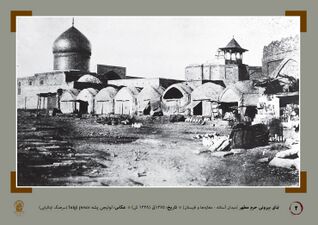 Exterior view of the Holy Shrine of Fatimah Ma'sumah (S.A.) from Astaneh Square (1859 CE).
 -
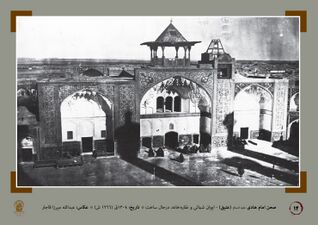 Atiq Courtyard and Naqqareh Khaneh (1887 CE).
 -
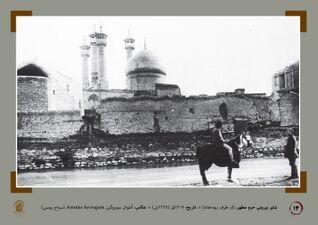 Exterior view of the Holy Shrine of Fatimah Ma'sumah (S.A.) from Qomrud River and the high walls built to prevent floods from entering the shrine (1890 CE).
 -
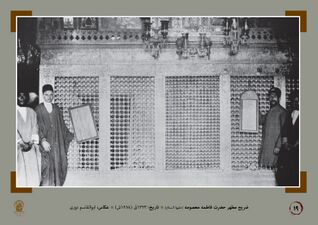 Zarih (enclosure) of the tomb of Fatimah Ma'sumah (S.A.) (1905 CE).
 -
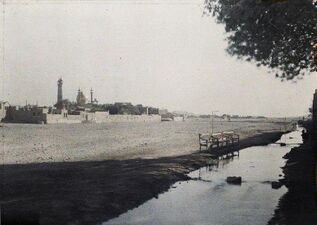 Panoramic view of the Holy Shrine of Fatimah Ma'sumah (S.A.) (1927 CE).
 -
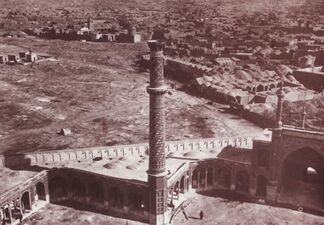 A view of a part of Atabaki Courtyard.
 -
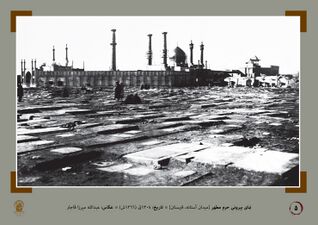 Exterior view of the Holy Shrine of Fatimah Ma'sumah from Astaneh Square (1887 CE).
 -
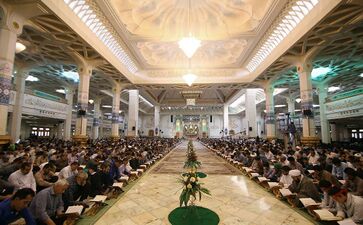 Group recitation of the Quran in Imam Khomeini Shabestan of the Holy Shrine of Fatimah Ma'sumah (S.A.).
 -
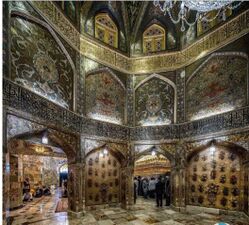 A view of one of the porticos of the Holy Shrine of Fatimah Ma'sumah (S.A.).
 -
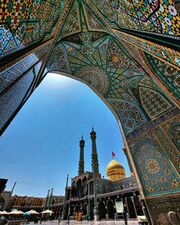 A view of the dome and minarets of Atabaki Courtyard of the Holy Shrine of Fatimah Ma'sumah (S.A.).


References
Plantilla:پانویس Plantilla:شاخه
- ↑ Qomi, Abbas ibn Mohammad Reza, Montaha al-Amal fi Tarikh al-Nabi wa al-Al, Qom, Daftar Nashr Islami, vol. 2, p. 378.
- ↑ Eshaqi, Sayyed Hossein, Mahtab Ahl al-Bayt (Un recorrido por la vida de Karimeh Ahl al-Bayt Hazrat Masumeh), Qom, Markaz Pazhuheshhaye Islami Seda wa Sima, 1386 H.Sh., pp. 3-6.
- ↑ Mohammadi Eshtehardi, Mohammad, Hazrat Masumeh (P) Fátima la Segunda, Qom, Nashr Akhlaq, 1380, pp. 178-179.
- ↑ Al-Majlisi, Bihar al-Anwar al-Jami'a li Durar al-Akhbar al-A'immah, Beirut, Dar Ihya al-Turath al-Arabi, 1403 H.L., vol. 57, p. 228.
- ↑ Mohammadi Eshtehardi, Hazrat Masumeh (P) Fátima la Segunda, pp. 178-179.
- ↑ Mohammadi Eshtehardi, Mohammad, «Hazrat Masumeh (P), la estrella brillante de la familia de Muhammad (P.B.U.H.)», Nashriyeh Pasdar Islam, n.º 177, 1357.
- ↑ Mohammadi Eshtehardi, Hazrat Masumeh (P) Fátima la Segunda, p. 159.
- ↑ Ibn Qulawayh, Ya'far ibn Mohammad, Kamil al-Ziyarat, investigación de Abd al-Hussein Amini, Nayaf, Dar al-Murtadawiyyah, p. 324.
- ↑ Para algunos ejemplos, véase: Mohammadi Eshtehardi, Mohammad, «Hazrat Masumeh (P), la estrella brillante de la familia de Muhammad (P.B.U.H.)».
- ↑ Qomi, Abbas ibn Mohammad Reza, Al-Fawa'id al-Razawiyyah fi Ahwal Ulama al-Madhhab al-Ja'fariyyah, investigación de Naser Baqeri Bidehndi, Qom, Bustan-e Ketab, 1385, p. 618.
- ↑ Qomi, Montaha al-Amal, vol. 2, p. 378; también: Qomi, Abbas ibn Mohammad Reza, Mafatih al-Jinan, Qom, Entesharat-e Osveh, sin fecha, p. 562.
- ↑ Para información detallada, véase: Mohammadi Eshtehardi, Hazrat Masumeh (P) Fátima la Segunda, pp. 191-219.
- ↑ Sadeghi Ardestani, Ahmad, Zanan-e Daneshman wa Rawi-e Hadith, Qom, Markaz-e Entesharat-e Daftar-e Tablighat-e Islami, 1377, pp. 350-351.
- ↑ Ibn al-Jazari, Mohammad ibn Mohammad, Asna al-Matalib fi Manaqib al-Imam Ali (P), Isfahán, Maktabat al-Imam Amir al-Mu'minin Ali (P) al-Ammah, pp. 50-51.
- ↑ Al-Qomi, Abbas ibn Mohammad Reza, Safinat al-Bihar wa Madinat al-Hikam wa al-Athar, Teherán, Dar al-Usrah li al-Tiba'ah wa al-Nashr, 1392, vol. 4, p. 545.
- ↑ Na'ini Ardestani, Mohammad Ali ibn Hossein, Anwar al-Mosh'asha'in, investigación de Mohammad Reza Ansari Qomi, Qom, Ketabkhaneh-ye Bozorg-e Hazrat Ayatollah al-Ozma Mar'ashi Najafi, vol. 1, p. 211; también: Rafiei, Ali, Tarikh-e Zendegani-e Imam Kazim (P), Teherán, Sepah-e Pasdaran-e Enqelab-e Islami, Namayandegi-e Wali-e Faqih, Edareh-ye Amoozeshhaye Aqidati Siyasi, p. 21.
- ↑ Rafiei, Tarikh-e Zendegani-e Imam Kazim (P), p. 21.
- ↑ Rafiei, Tarikh-e Zendegani-e Imam Kazim (P), p. 21.
- ↑ Rafiei, Tarikh-e Zendegani-e Imam Kazim (P), p. 21.
- ↑ Mahallati, Rayahin al-Shari'ah, vol. 5, p. 31.
- ↑ From Birth to Death, Comprehensive Portal of the Holy Shrine of Lady Fatimah Ma'sumah (SA), date of article: 1398, date of visit: 1401.
- ↑ A group of authors, Encyclopedia of Imam Kadhim (AS), undated, Ashura Specialized Website, undated, p. 338.
- ↑ Elhami, Davood, A Journey Through the History of Shi'ism, Qom, Maktab-e Islam, 1375, p. 545.
- ↑ Hosseini, Seyyed Javad, "The Secret of Lady Ma'sumah's (SA) Unmarried Status," Farhang-e Kowsar, 1386, no. 69.
- ↑ Faghihi, Ali-Asghar, Religious History of Qom, Qom, Zaer Publications, 1387, p. 92.
- ↑ From Birth to Death, Comprehensive Portal of the Holy Shrine of Lady Fatimah Ma'sumah (SA), date of article: 1398, date of visit: 1401.
- ↑ Rafiei, History of the Life of Imam Kadhim (AS), pp. 24-25.
- ↑ 23rd of Rabi' al-Awwal, the anniversary of the arrival of Lady Fatimah Ma'sumah (SA), Library of the School of Fiqh, date of article: 1396, date of visit: 1401.
- ↑ Tashid, Ali-Akbar, Hediyeh-ye Esma'il or the Uprising of the Alawi Sayyids for the Caliphate, Tehran, Dar al-Kutub al-Islamiyah, 1385 SH, p. 166.
- ↑ Pak, Mohammad Reza, "Qom in the First Two Centuries of Hijra," History of Islam, Islamic Propagation Office of Qom Seminary, 1382, no. 14, p. 10.
- ↑ Plantilla:Journal citation
- ↑ Ibn Qulawayh, Ja'far ibn Muhammad, Kamil al-Ziyarat, Najaf Ashraf, Dar al-Murtadawiyah, first edition, 1356 AH, Chapter 106, p. 324, Hadith 1.
- ↑ Ibn Babawayh, Muhammad ibn Ali, Uyun Akhbar al-Reza (peace be upon him), Tehran, Nashr Jahan, first edition, 1378 AH, Chapter 67, vol. 2, p. 267, Hadith 1.
- ↑ Ibn Qulawayh, Ja'far ibn Muhammad, Kamil al-Ziyarat, Najaf Ashraf, Dar al-Murtadawiyah, first edition, 1356 AH, Chapter 106, p. 324, Hadith 2.
- ↑ Al-Majlisi, Bihar al-Anwar, vol. 99, pp. 266-267; also: Al-Majlisi, Muhammad Baqir, Tuhfat al-Za'ir, Qom, Imam Hadi (AS) Institute, 1386 AH, p. 4; also: Al-Majlisi, Zad al-Ma'ad, Beirut, Mu'assasat A'lami lil Matbu'at, 1423 AH, pp. 548-547.
- ↑ Al-Majlisi, Bihar al-Anwar, vol. 99, pp. 266-267.
- ↑ Kiani, Yusuf, "The Complex of the Shrine of Lady Ma'sumah (SA)", Faculty of Literature and Humanities, University of Tehran, No. 151, Autumn 1999, p. 64.
- ↑ Sajjadi, Sadegh, "The Shrine of Lady Ma'sumah", The Great Islamic Encyclopedia, Tehran, Center for the Great Islamic Encyclopedia, vol. 1, p. 360.
- ↑ Sajjadi, "The Shrine of Lady Ma'sumah", The Great Islamic Encyclopedia, vol. 1, pp. 358-362.
- ↑ Sotoudeh, Manouchehr, Inscriptions of the Holy Shrine of Lady Ma'sumah (SA) and its surrounding courtyards, Qom, Library of Grand Ayatollah Mar'ashi Najafi, 1996, p. 19.
- ↑ Rezaei Nadushan, "The Evolution of the Shrine of Lady Ma'sumah (SA)", Iranian Architectural Studies, p. 92.
- ↑ 42,0 42,1 Sajjadi, "The Shrine of Lady Ma'sumah", The Great Islamic Encyclopedia, vol. 1, p. 359.
- ↑ Vazin Afzal, Mehdi, "Development of the Shrine of Lady Ma'sumah and Increase of Pilgrims to Qom during Naser al-Din Shah's Reign", Research in History, Second Year, No. 3, Autumn 2011, p. 65.
- ↑ 44,0 44,1 44,2 "Shrine of Lady Ma'sumah", Reiseniran website, date of publication: June 3, 2022, date of visit: January 4, 2023.
- ↑ Sajjadi, "The Shrine of Lady Ma'sumah", The Great Islamic Encyclopedia, vol. 1, p. 360.
- ↑ Sajjadi, "The Shrine of Lady Ma'sumah", The Great Islamic Encyclopedia, vol. 1, pp. 360-361.
- ↑ "Shrine of Lady Ma'sumah" Reiseniran website.
- ↑ "Shrine of Lady Ma'sumah" Reiseniran website.
- ↑ Sajjadi, "The Shrine of Lady Ma'sumah", The Great Islamic Encyclopedia, vol. 1, pp. 360-361.
- ↑ Sajjadi, "The Shrine of Lady Ma'sumah", The Great Islamic Encyclopedia, vol. 1, pp. 359-360.
- ↑ "Historical evolution of the holy zarih of Lady Ma'sumah (SA) from beginning to present", ISNA, date of publication: August 10, 2016, date of visit: January 1, 2023.
- ↑ Sajjadi, "The Shrine of Lady Ma'sumah", Center for the Great Islamic Encyclopedia, vol. 1, p. 360.
- ↑ Nadushan, Mohammad Rezaei, "The Evolution of the Shrine of Lady Ma'sumah (SA)", Iranian Architectural Studies, No. 16, Autumn and Winter 2019, p. 92.
- ↑ ""The Holy Shrine of Lady Ma'sumah (peace be upon her) (Qom)", Islamic Education (Endowment Organization), No. 29, September 1978, p. 56.
- ↑ Sajjadi, "The Shrine of Lady Ma'sumah", The Great Islamic Encyclopedia, vol. 1, p. 360.
- ↑ Faqih Mirzai, Hossein, "Renovation plan for the dome of the holy shrine of Lady Fatimah Ma'sumah (SA)", Hawzah Information Center, date of publication: April 22, 2003, date of visit: January 3, 2023.
- ↑ "History of the Shrine of Lady Ma'sumah (SA)", Hawzah Information Center, date of publication: July 15, 2018, date of visit: January 1, 2023.